The last link in the chain
The Mysterious Affair at StylesThe last link in the chain is Hercule Poirot’s term for the final piece of evidence needed to convert a coherent explanation of Emily Inglethorp’s death into a provable case. Its importance lies in the gap it names: Poirot may know who is guilty and how the poisoning worked, yet suspicion alone cannot withstand legal scrutiny. The phrase therefore describes both a missing clue and the standard of proof his investigation must meet.
What the Link Means
When Poirot explains that he lacks the last link in his chain, he distinguishes private certainty from evidence sufficient to convict. He says he knows John Cavendish is guilty but has terribly little evidence; without the missing link, his conclusion cannot safely become a legal finding. The expression gives a concrete image to that distinction: a chain of reasoning may appear complete in outline, but one absent connection leaves it unable to hold.
The metaphor also captures Poirot’s method of testing apparently decisive facts rather than accepting them at face value. At the inquest, a chemist’s assistant identifies Alfred Inglethorp as the purchaser of strychnine. Yet Poirot argues that this evidence is too conclusive: a criminal has manufactured a tightly fitting case against Alfred, and its very neatness gives away the attempt to frame him. The link that matters is not simply the most dramatic fact, but one that survives examination and connects the crime to its actual mechanism.
The Search Through Competing Explanations
The investigation begins with the assumption that Emily Inglethorp died of strychnine administered in her coffee. Poirot asks when the coffee was served, treating the timing as a test of the proposed explanation rather than as a settled detail. As the evidence accumulates, his attention shifts from the obvious accusation to whether each circumstance can genuinely explain the death.
The suspicion around Alfred illustrates how a chain can be assembled falsely. Poirot acknowledges that Alfred’s excuse for being away from the house was conspicuously contrived, but says this leaves two possibilities: Alfred knew what was going to happen, or he had another reason for his absence. The suspicious absence does not by itself establish which explanation is true. Similarly, the chemist’s identification seems to close the case, but Poirot regards its precision as evidence that someone has deliberately made the accusation look complete.
The supposed evidence against John also requires scrutiny. Objects found in an unlocked drawer in his room would be an unlikely place for a murderer to leave incriminating material for a week, giving ample time to remove or destroy it. At trial, handwriting experts say the signature in the poison register is not Alfred’s, while conceding that it might be John’s disguised hand or a clever counterfeit. Neither possibility settles authorship. The defence emphasizes that the prosecution has not proved John ordered the black beard or concealed the strychnine, showing how the same details can suggest guilt while remaining inadequate to prove it.
The Missing Proof and the Card House
Poirot makes the difficulty visible through a card house. He can build one seven stories high, but cannot find the last link; he then rebuilds it card by card, with mathematical precision. The image sets construction against verification. A persuasive account can rise quickly from connected clues, but its height does not compensate for a missing support, and confidence cannot substitute for the evidence that completes the structure.
That distinction is especially sharp when Hastings asks whether John will be condemned. Poirot answers that acquittal is likely because there is so little evidence, even though Poirot himself believes John guilty. The phrase thus measures two different kinds of knowledge: the detective’s understanding of the case and the court’s need for proof. It is not enough for the explanation to feel right; a final piece must connect it to a fact that cannot be explained away as coincidence or fabrication.
Discovery and Resolution
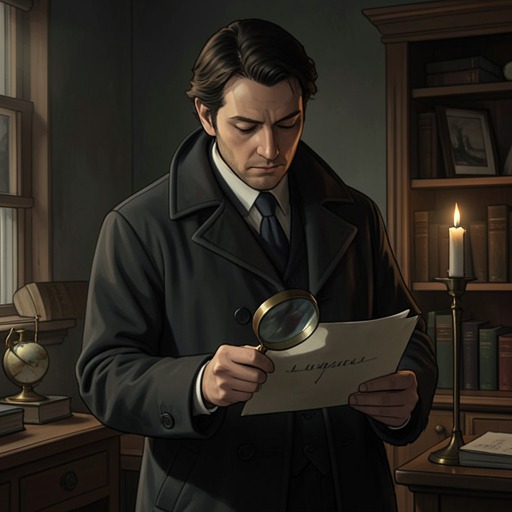
The decisive link is not found in the obvious evidence against a suspect. Poirot eventually reveals that it was in the spill vase in Emily Inglethorp’s bedroom, where he discovered a letter in the murderer’s own handwriting. He says Hastings’s earlier account of Poirot straightening the mantel ornaments helped lead to the discovery. The hidden letter supplies the direct connection that the circumstantial case had lacked.
The letter also clarifies why the timing of the death mattered. The crime had been intended for Monday evening, when Emily’s bell wire had been cut and Cynthia was away overnight, leaving Emily isolated. But Emily forgot to take her medicine before going out to a village entertainment, then spent the following day away at lunch. The fatal dose was therefore taken twenty-four hours later than intended. That delay allowed the final proof to come into Poirot’s hands; the letter had warned Emily of danger, but not clearly enough for her to recognize how it would reach her.
By naming the discovered letter the last link, Poirot closes the distance between a reconstructed mechanism and a provable accusation. The expression’s force comes from the investigation’s reversals: evidence that first seems conclusive can be manufactured, while the genuine proof remains hidden in an ordinary bedroom object. The chain is complete only when explanation and evidence meet.